Consistent practice, understanding fundamental principles, and preparing those principles for revision are keys to performing well in math.
Utilization of sample papers, and timed or mock tests can develop speed and accuracy going into exams in 2025.
Taking advantage of the help of a teacher or the enabled resources of the internet can cultivate confidence and performance.
Table of Contents
Are you having difficulty figuring out how to score good marks in maths? You are not the only one—maths is notoriously difficult competency for many students; however, with the proper strategies and mindset, all students can flourish. With many students preferring maths to be more of a challenge in 2025, getting good marks is no longer just a question of factually remembering formulas, but rather building good concepts, regular practice, and good problem-solving techniques. This applies whether you are preparing for a board exam, an entrance exam, or even just aiming to improve classroom performance in maths, good skills in maths will help you to pursue a plethora of exciting academic and career options.
This guide has been developed for students to provide worthwhile tips, guides, and expert advice, so you’re ready to boost your maths score. Time management and revision, and practical approaches to solving more challenging questions can motivate you and allow you to take full advantage of your maths study to improve your result.
What Causes Students to Struggle with Mathematics?
Mathematics is often perceived as one of the most challenging subjects among students of all age groups. This struggle stems from a mix of psychological, educational, and practical reasons that, when unaddressed, can lead to long-term learning difficulties.
Common Reasons Students Struggle with Maths:
Fear and Anxiety: Maths anxiety is real. The fear of getting the wrong answer or being judged can create a mental block, preventing students from even attempting problems.
Lack of Conceptual Understanding: Many students try to memorize formulas without understanding the underlying principles. This makes it difficult to apply concepts in varied contexts or solve word problems.
Poor Foundation: Maths is a cumulative subject. If foundational concepts like addition, multiplication, or fractions are weak, it becomes harder to grasp advanced topics like algebra or calculus.
Learning Gaps and Pace Issues: Students learn at different speeds, but classroom teaching often moves at a fixed pace. Those who fall behind may never get the chance to catch up.
Limited Real-World Connection: When students don’t see how math applies to everyday life, it can feel abstract and irrelevant, leading to disinterest.
Ineffective Teaching Methods: Not every teaching method resonates with every learner. A lack of personalized instruction or interactive tools can hinder engagement and understanding.
Psychological Strategies for Math Success
Success in mathematics is not only about mastering formulas and problem-solving techniques-it also depends on mental preparedness and emotional resilience. By integrating psychological strategies into your study routine, you can significantly reduce anxiety and improve performance.
1. Stress Management Techniques
Managing stress ensures that your mind stays clear during both preparation and exams. Techniques include:
Timed practice sessions to simulate exam conditions and build confidence.
Regular breaks to avoid mental fatigue.
Exercise or light physical activity to release tension and boost focus.
2. Mindfulness Practices
Mindfulness helps students stay present and focused while studying or solving complex problems. Some practices include:
Deep-breathing exercises before and during study sessions.
Meditation for 5–10 minutes daily to enhance concentration.
Visualization techniques, imagining yourself confidently solving problems in the exam.
3. Building a Growth Mindset
A growth mindset encourages students to view challenges as opportunities rather than threats. Strategies include:
Emphasizing effort over perfection, celebrating progress rather than just results.
Learning from mistakes, reviewing errors to understand concepts better.
Positive self-talk, using affirmations such as “I can improve with practice” to reinforce confidence.
Example: Many top-performing students practice mindfulness before exams, which helps them stay calm, think clearly, and tackle difficult questions with a composed mindset.
Tip: Combine these strategies with regular study and problem-solving practice. Over time, students not only improve their math skills but also develop resilience and confidence that extend beyond exams.
Setting Up for Solutions
Understanding why students struggle is the first step toward helping them succeed. With the right strategies ranging from building a stronger foundation to using real-life examples and tech-based tools students can overcome these hurdles and develop confidence in their math skills.
Ready to explore practical, easy-to-apply tips to help students conquer their fear of numbers? Let’s dive in.
Real-World Applications of Mathematics
Mathematics is not just a subject in school-it plays a vital role in everyday life and across various professions. Understanding its practical applications can make learning more engaging and meaningful.
1. Engineering and Technology
Electrical, civil, and mechanical engineers use algebra, calculus, and trigonometry to design structures, circuits, and machinery. For instance, an electrical engineer calculates current and voltage to ensure circuits work safely and efficiently.
2. Finance and Economics
Mathematics is the backbone of financial planning, investment analysis, and budgeting. Professionals use statistics, percentages, and compound interest formulas to make decisions and forecast trends.
3. Data Science and Artificial Intelligence
Data scientists and AI specialists rely on probability, linear algebra, and statistics to analyze data, build algorithms, and predict outcomes. For example, recommendation systems in apps like Netflix or Amazon are built using mathematical models.
4. Daily Life
From calculating expenses, measuring ingredients in recipes, or figuring out travel time, mathematics is part of everyday decision-making. Even simple activities like splitting a bill with friends involve basic arithmetic.
Example: A civil engineer designing a bridge uses calculus and geometry to ensure the structure can safely handle traffic loads. This demonstrates how mastering math directly impacts professional success and societal safety.
Tip: Whenever you learn a new math concept, try to connect it with a real-life scenario. This improves understanding and makes problem-solving more intuitive.
Top 10 Tips on How to Score Good Marks in Maths
Scoring good marks in math requires a combination of understanding concepts and regular practice. How to score good marks in Maths: You will also know how to score good marks in maths class 10. Here are some tips to help you answer how to get good marks in maths:
1. Practice Regularly
Mathematics requires a consistent approach to improve your problem-solving skills and understanding of concepts. Set aside dedicated time daily to solve math problems and practice different questions. When practicing mathematical problems, double-check your results using an online platform like Allmath, which offers a wide range of calculators that deliver quick answers along with step-by-step solutions.
2. Understand Concepts
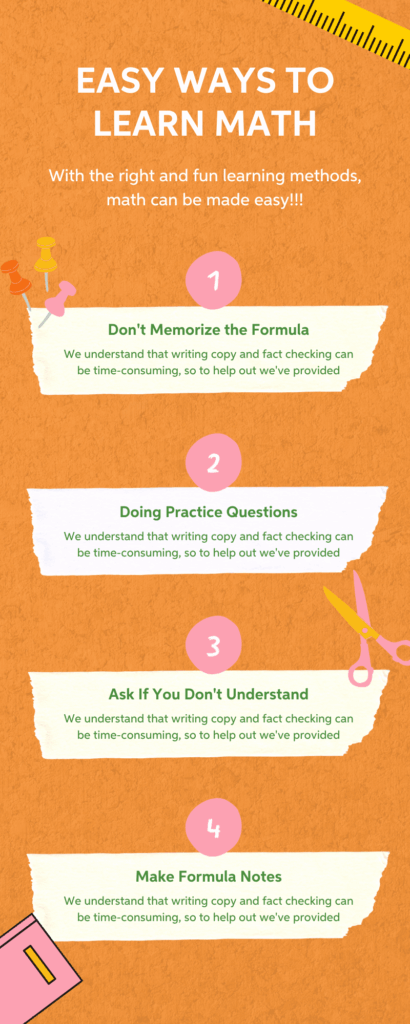
Instead of learning formulas by heart, concentrate on comprehending the underlying ideas and consider how to get high grades in mathematics. You will be better able to apply mathematical concepts to a variety of problems if you understand their ideas and logic.
3. Make a Study Plan
For every study session, make a well-organized study schedule with clear goals and subjects. To find out how to get good grades in math, break down your syllabus into manageable chunks and set aside time for reviewing and practicing various questions.
4. Identify Weak Topics
Assess your strengths and weaknesses in different math topics. Identify the areas where you face difficulties and dedicate more time to understanding and practising those topics. And take help from teachers if needed and ask them how to score good marks in maths.
5. Seek Clarity
Ask for clarification right away if you have any questions or concerns while studying. By clearing up your doubts as soon as possible, you can avoid any misconceptions from persisting and impairing your comprehension of the topic. This is one of the most crucial things to consider when considering how to receive perfect scores in math.
6. Practice Previous Years’ Question Papers
Solve previous years’ question papers. This will also give you a sense of which topics are usually covered and help you focus your preparation properly. By practising, you will know how to score good marks in maths in one day.
7. Develop Problem-Solving Strategies
Develop the ability to solve problems effectively by identifying important information, using the right formulas or approaches, and breaking down complex problems into smaller steps. Practice using these techniques on a range of mathematical problems.
8. Use Visual Aids and Diagrams
If you’re thinking about how to score good marks in maths, utilize visual aids, diagrams, and graphs to understand and represent mathematical concepts. Visualizing problems can provide additional insights and make complex ideas more understandable.
9. Review and Revise
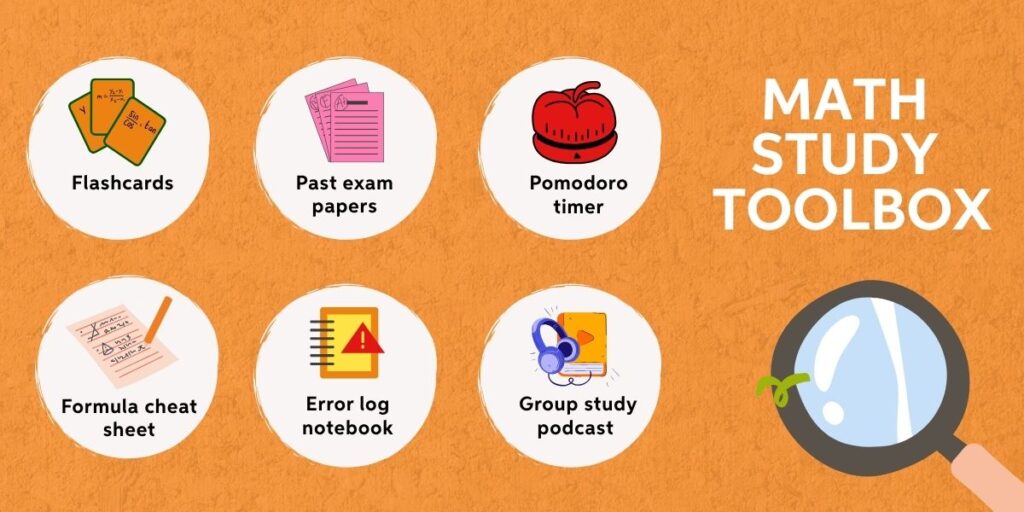
To facilitate speedy revision, create brief notes or flashcards that highlight important formulas, ideas, and problem-solving strategies. For practice, read and edit daily. If you think about how to score full marks in maths, revising is the most important task.
10. Stay Calm and Manage Time
During exams, staying calm and managing your time effectively is crucial. Avoid getting stuck on challenging questions and move on if needed, ensuring you attempt all questions.
Note: Consistent effort, practice, and a positive mindset are essential to scoring well in mathematics.
Mistakes to Avoid to Get Full Marks
As previously stated, getting good grades in maths is not tough if you do everything correctly. “How to score good marks in maths without studying” is the central question that arises in everyone’s mind. Maths is one of those topics where scoring is simple if the question is answered correctly. As a general guideline, avoid the following common blunders if you wish to get full marks in maths.
1. Making a Study Plan
The first step in learning how to get good grades in math is creating a study plan. Some students start their exam preparation in an unplanned and haphazard manner. They are unable to rewrite crucial subjects, though. Therefore, starting early and creating a study schedule that you can stick to is the simplest way to achieve full grades in a subject like math.
2. Not using previous years question papers as practice
One of the best ways to get good grades in math is to solve the previous year’s exam papers. Through their curriculum, students will be able to learn the important themes, marking scheme, and exam pattern. Question papers from prior years are now widely available online. Get these and repeat the questions until you understand the pattern.
3. Inadequate Practice
Most pupils struggle with a lack of practice. With enough practice, one might become accustomed to the strategies employed for certain questions, saving time during the examination. You cannot solve the questions quickly if you do not practice sufficiently. Thus, you may lose marks. As a result, obtain as much practice as possible to pass your maths exam with flying colours.
Regular practice will not only help you retain material but will also improve your understanding of the themes.
4. Incorrectly answering questions
Both basic math and standard math contain both easy and challenging problems. “How can I get full marks in math?” was a common question you had as a child. Complex questions can be confusing to students, but basic questions are simple to understand. This is a result of their inability to understand the requirements of the question. You can better grasp what the question is trying to ask if you carefully read it. Read the questions carefully and make an effort to analyze them before selecting an answer.
Simple Steps for Attempting a Maths Paper
Many students find mathematics difficult, but with the appropriate tactics, you may enhance your performance and do well in maths tests. How to score good marks in maths? One important aspect of performing well in math exams is knowing how to attempt the paper effectively.
1. Utilize the Reading Time
Most exams give students a few minutes of reading before the exam starts. Use this time wisely to read through the entire question paper. Determine the sorts and level of questions being asked so that you can plan your time appropriately. You will know exactly what to anticipate and be able to outline your strategy for each section if you do this you’ll know how to score good marks in maths.
2. Prioritize Easy Questions
When you start attempting the paper, begin with the questions you find easy and are confident about. Solving familiar and straightforward questions first will save time and boost your morale, positively impacting your performance in the rest of the paper.
3. Time Management
Time management is crucial when attempting a math paper. Consider the marks allotted, and allocate a specific time to each section or question. You can always come back to the challenging questions later if time permits.
4. Maintain Speed and Accuracy
While attempting the math paper, it’s important to maintain a balance between speed and accuracy. How To Score Good Marks In Maths: Be mindful of your pace and try to solve questions efficiently without compromising on the accuracy of your answers. Rushing through the paper may lead to mistakes while being too cautious can cost you valuable time. Find a comfortable speed to solve questions accurately within the allocated time.
5. Focus on Step-by-Step Solutions
How To Score Good Marks In Maths: In math exams, showing your work and steps is crucial, especially for questions requiring lengthy calculations. Even if you make a small calculation error, but show the correct steps, you may still receive partial marks. Additionally, presenting your solutions neatly and in a structured manner can make it easier for the examiner to follow your thought process and award you the appropriate marks.
6. Revise and Review
Once you have attempted all the questions within the given time, review your answers. Use any remaining time to double-check your figures, ensuring you have answered all portions of each question and correct any errors. This final review can help you identify and rectify errors before submitting your paper.
7. Practice, Practice, Practice
Regular practice is the key to enhancing your math exam performance. Solve math problems from many sources, such as textbooks, workbooks, and online resources. The more you practice, the better you understand various concepts and solve issues efficiently. The practice also helps you become familiar with the exam format, question patterns, and time constraints.
Note: Remember, effective time management, prioritizing easy questions, maintaining speed and accuracy, and presenting your solutions are crucial strategies to attempt a math paper successfully. How to Score Good Marks in Maths: By implementing these strategies and practising regularly, you will understand how to score 100 in maths and how to score good marks in maths exams.
Daily Routine to Score Well in Maths
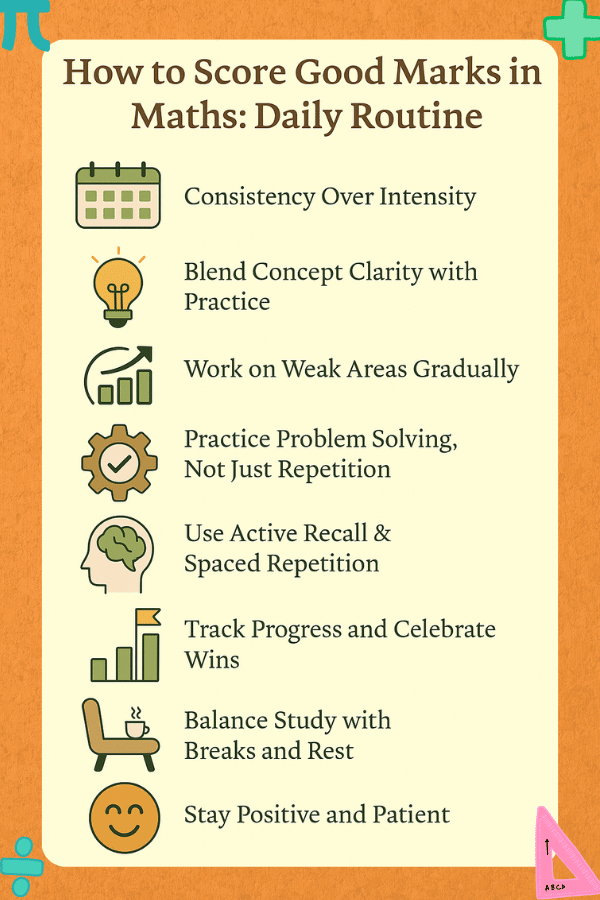
Improving your maths scores isn’t about studying all day-it’s about making every minute count. A consistent daily routine helps reduce stress, build confidence, and reinforce learning over time. Rather than following a rigid schedule, focus on creating a routine that includes key habits to strengthen your math skills and mindset to achieve how to score good marks in maths-
1. Consistency Over Intensity
Studying maths daily-even for shorter durations-is far more effective than cramming. Set aside time every day for practice, and treat it like brushing your teeth: non-negotiable.
2. Blend Concept Clarity with Practice
Spend time understanding the why behind each topic, not just the how. Follow it up with practice questions that apply those concepts in different ways. The goal is to learn to think through problems, not just solve them mechanically.
3. Work on Weak Areas Gradually
Don’t ignore topics you find hard. Include a small chunk of time daily to revisit difficult concepts or errors from previous tests. Overcoming your weak areas, even slowly, will massively improve your scores.
4. Practice Problem Solving, Not Just Repetition
Doing 100 similar problems won’t help if they don’t make you think. Instead, solve a variety of question types word problems, application-based questions, and logical puzzles to sharpen your analytical skills.
5. Use Active Recall & Spaced Repetition
Don’t just re-read your notes. Use flashcards, quiz yourself, or solve problems from memory. Spread out revision of old chapters across days-this improves retention and confidence during exams.
6. Track Progress and Celebrate Wins
Keep a log of chapters covered, scores improved, and problem types mastered. This gives a sense of progress and keeps motivation high. Even small wins deserve a pat on the back!
7. Balance Study with Breaks and Rest
Avoid long, draining sessions. Take short breaks to refresh your brain and avoid burnout. Also, make sure you’re getting enough sleep-tired minds don’t solve problems well.
8. Stay Positive and Patient
Improving in maths takes time. Some days will feel frustrating and that’s okay. Remind yourself that progress is happening, even if it’s slow. A positive mindset is your best companion on this journey.
Interactive Learning Tools for Mathematics
To strengthen understanding and make learning more engaging, using interactive platforms and tools can be highly effective. These resources provide step-by-step solutions, practice problems, and visual explanations, helping students reinforce concepts and track progress.
Recommended Tools:
Khan Academy – Offers free video tutorials and exercises across all math topics, from algebra to calculus, with instant feedback.
Mathway – Allows students to input problems and get step-by-step solutions, helping them learn problem-solving techniques.
Wolfram Alpha – A computational engine that solves complex problems and provides detailed explanations and graphs.
GeoGebra – An interactive platform for visualizing geometry, algebra, and calculus concepts.
Photomath – Lets students scan handwritten or printed math problems and see instant solutions with explanations.
Peer Learning
Collaborative learning can significantly improve understanding and retention of mathematical concepts. Study groups, peer discussions, and collaborative problem-solving create an environment where students can learn from each other, clarify doubts, and explore multiple approaches to the same problem.
Benefits of Peer Learning:
Enhanced Understanding – Explaining concepts to peers reinforces your own knowledge.
Different Perspectives – Learning alternative methods or shortcuts can simplify complex problems.
Motivation and Accountability – Group study keeps students disciplined and motivated.
Achieving excellence in mathematics is attainable for every student through the implementation of effective strategies and sustained commitment. By prioritizing conceptual understanding, maintaining consistent practice routines, and employing strategic revision methods, students can successfully navigate mathematical challenges while developing enduring confidence in their analytical capabilities. It is essential to recognize that errors constitute an integral component of the learning process and should be utilized as valuable opportunities for growth and skill enhancement.
Students are encouraged to maintain motivation, actively seek assistance when necessary, and remain open to exploring diverse educational resources and study methodologies. Through the cultivation of patience and perseverance, academic achievement in mathematics becomes increasingly attainable, simultaneously creating pathways to expanded academic opportunities and enhanced career prospects. By maintaining self-confidence, committing to regular practice, and applying these fundamental principles, success in mathematics naturally follows.
Evaluate numerous career choices to choose the right career path for yourself. Dive into our guide on CareerAdvice.
Frequently Asked Questions (FAQ’s)
How to get an A* in maths?
To get an A* in maths, you can do the following:
1. Become familiar with the syllabus and the exam format. 2. Set up a study timetable and comply with the study plan. 3. Work through past papers in exam setting time constraints. 4. Spend extra time on weak topics, and get help if needed. 5. Research online resources and tutorial videos to support. 6. Regularly review and summarise notes and key formulae. 7. Join study groups for collaborative learning. 8. A balance of study and rest will help too. 9. Add Image 10. Can a student who is not doing well get better at maths?
Can a weak student become good at maths?
A weak student can improve maths with the right approach and effort. Here are some tips: 1. Start by strengthening the basics and understanding fundamental concepts. 2. Develop a positive attitude towards math and believe in your ability to improve. 3. Break down complex problems into smaller steps for better understanding. 4. Stay persistent, and do not get discouraged by initial difficulties.
Why am I not getting good marks in maths?
You may not get good maths marks for various reasons. Consider the following factors: 1. Insufficient practice and lack of regular revision. 2. Inadequate understanding of key concepts. 3. Poor time management during exams. 4. Difficulty in applying concepts to problem-solving. 5. Lack of confidence or a negative mindset towards math. 6. Insufficient guidance or support from teachers. 7. Identifying the areas where you struggle and addressing them with targeted practice and help can help improve your performance.
How to get 40% in math?
To achieve a score of 40% in maths, focus on the following strategies:
Focus on important topics that appear often in exams. Solve past papers to understand question types. Use textbooks, online videos, and tutorials for tough areas. Attend extra classes or revision sessions. Plan your study time wisely for each topic. Take short breaks to stay focused. Ask teachers or friends for help with difficult concepts. Stay consistent and keep practising daily.
How to score 100% in maths?
Focus on Important Topics. Compile a List of Tough Formulas. Proper Time Management. Attempt Familiar Questions & Draw Graphs. CBSE Examination Pattern 2024. Way Forward.
How to get a good score in mathematics?
To get a good score in mathematics, focus on understanding concepts, practicing regularly, solving previous papers, and clearing doubts promptly. Maintain a study schedule, revise formulas daily, and attempt mock tests to build confidence and improve problem-solving speed.
Why am I very weak in maths?
Think about scrutinizing your study habits, obtaining further support, and practicing regularly. Try to recognize what areas you are having trouble with so you can direct your efforts at these areas.
Authored by, Mansi Rawat Career Guidance Expert
Mansi crafts content that makes learning engaging and accessible. For her, writing is more than just a profession—it’s a way to transform complex ideas into meaningful, relatable stories. She has written extensively on topics such as education, online teaching tools, and productivity. Whether she’s reading, observing, or striking up a conversation while waiting in line, she’s constantly discovering new narratives hidden in everyday moments.